
From Using AI to Leading with AI: CIDB Malaysia's Top Leadership Charts an AI-Enabled Future
9 October 2026 — Fourteen of CIDB Malaysia's most senior leaders, including heads of its subsidiaries and agencies, spent a morning not learning a new tool, but learning how to lead an organisation that uses one. The Executive AI Briefing, Leading an AI-Enabled Organisation, was delivered by CIDB Digital Sdn Bhd with HPCS Sdn Bhd as training partner at Pullman Hotel.
Why now
Malaysia's construction sector recorded RM178.6 billion of work done in 2025, up 12.5%, and the National Construction Policy (NCP) 2030 aims to digitalise at least half of the construction cycle by 2030. Around the world, 88% of organisations already use AI in at least one function, yet only 7% say it is fully scaled. The gap between using AI and leading with AI is a leadership gap, and that was the gap this programme set out to close.
Programme highlights
- Half-day, executive format: 210 minutes, 70% briefing and 30% hands-on practice, run on ChatGPT.
- One rhythm per module: Brief, Show, Try, Commit. Every idea was framed for CIDB, demonstrated live, tried by the leaders themselves and turned into a written commitment.
- Safe by design: the first act of the morning was switching off model training on every account, and every exercise used public or dummy data only.
- Built on CIDB's own work: public CIDB circulars, a CIDB annual report and DOSM construction statistics were used throughout.
- Latest technology: the session came two days after GPT-6 rolled out to ChatGPT users, giving leaders a timely view of where AI capability is heading.
Programme modules in summary
The morning opened with a short positioning session that framed AI as a leadership lever for CIDB's mandate. Before the first prompt, every leader switched off model training on their account, setting the tone for responsible use throughout the programme.
Module 1 - AI Landscape for the Construction Sector, distinguished generative AI, which creates drafts and summaries, from analytical AI, which predicts delays, scores risk and detects anomalies. Leaders reviewed where AI is already changing design, project delivery, site safety and regulatory services, and mapped their own division's bottlenecks against Malaysia's policy frame, including NCP 2030 and the Public Sector AI Guidelines.
Module 2 - Prompting for Leaders, introduced the PCTC framework of Persona, Context, Task and Constraints. Working in pairs on a public CIDB circular, leaders wrote, scored and improved their own prompts, seeing first-hand how a structured brief turns a generic paragraph into a usable table of obligations. This module was later rated the most valuable of the morning.
Module 3 - Strategic Reporting, showed a 40-page public CIDB report becoming a one-page board brief built on a headline, findings, risks and the decision required. A simple source-check instruction made every finding carry its page number, and the room verified three citations before accepting the result.
Module 4 - Data-Driven Decisions, demonstrated how leaders can question a dataset in plain English. Using public DOSM construction statistics for 2025, ChatGPT calculated and charted the answers, and participants challenged each chart on its axis, its period and what it left out.
Module 5 - Workflow Automation, set out three tests for choosing work to automate: frequent, rule-based and low risk. A role-played meeting was dictated by voice and returned as formal minutes in CIDB's format, complete with decisions, owners and due dates, and leaders saw how a Custom GPT can turn a proven prompt into a tool for the whole team.
Module 6 - Stakeholder Communication, applied a three-act structure of situation, complication and resolution to change messages. Leaders adapted a single message for the Ministry, the Board and contractors, keeping the facts identical while AI handled the drafting and leaders retained the voice and the final approval.
Module 7 - Ethics, Cybersecurity and Governance, established the Traffic Light rule for AI: public data may be used freely, internal data must be anonymised first, and personal or classified data must never be uploaded. The module covered PDPA 2010, the Cyber Security Act 2024 (Act 854) and government security classifications, and drew lessons from real incidents involving fabricated citations, deepfake fraud and data leakage.
Module 8 - CIDB AI Action Plan, brought the morning together. Each leader reviewed the lines recorded on their Action Plan card, placed them on an impact-and-effort grid and selected one quick win, producing a departmental AI commitment with an owner, a metric and a 30-day review date.
Key people
The programme brought together CIDB Malaysia's top management from the Office of the Chief Executive and the offices of both Deputy Chief Executives, heads of policy, technology, human resources and legal, and the heads of CREAM, CLAB, CIDB Holdings, CIDB Technologies, CIDB Digital and CIDB IBS.
HPCS x CIDB Digital : what was delivered
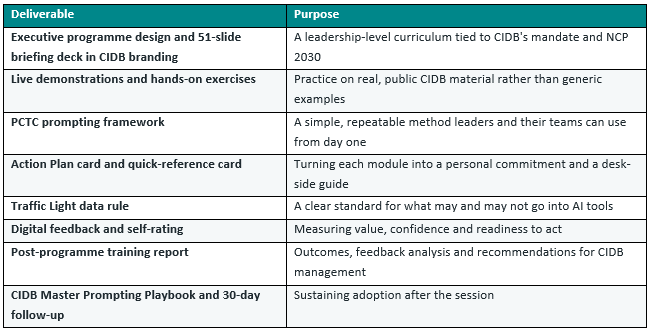
What was achieved
- Every participant left with a departmental AI commitment carrying an owner, a metric and a review date.
- Leaders agreed on a shared Traffic Light rule: public data used freely, internal data anonymised first, personal or classified data never uploaded.
- A clear set of quick wins was identified for most divisions: meeting minutes, recurring briefs, standard replies to enquiries and monthly report templates.
- A path forward was mapped: commitment review, AI champions in every division, an AI usage policy and capability building for teams.
What participants said
- 4.56 out of 5 for overall value; every respondent rated the programme 4 or 5.
- Net Promoter Score of +78: every respondent scored 8 or above when asked whether they would recommend it to other CIDB leaders.
- Confidence to lead AI adoption rose from 2.9 to 4.2 out of 5.
- Prompting for Leaders was named the most valuable module by seven of nine respondents.
- The pace was rated "about right" by every respondent.
What comes next
A 30-day review will check progress on each departmental commitment, supported by the CIDB Master Prompting Playbook. Participants identified team skills as the main factor in scaling adoption, pointing to hands-on workshops for division champions as the natural next step.
AI doesn't replace leadership. It amplifies it.
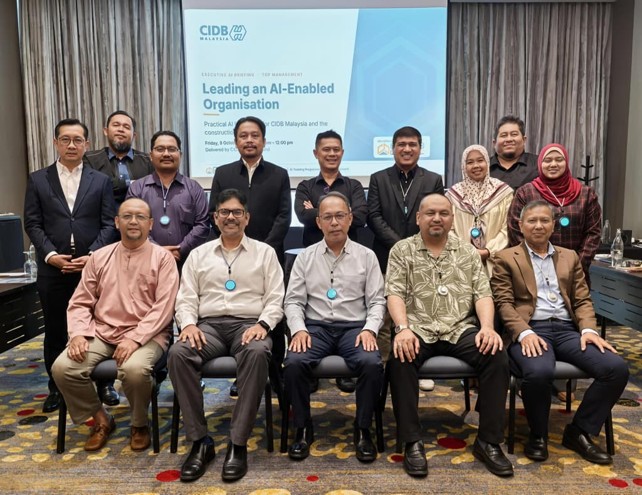
CIDB Malaysia's top management and subsidiary heads with the programme team, 9 October 2026.
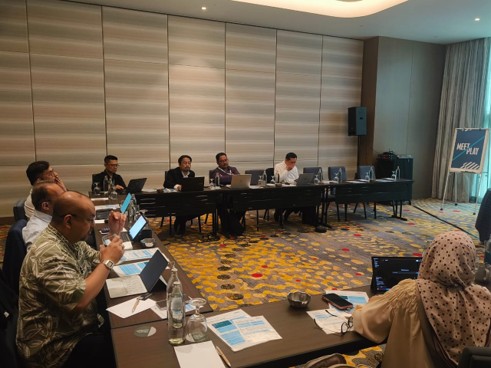
Hands-on practice on real, public CIDB material.


